Learning things is slow, but it doesn’t have to be. We are taught bottom up: you start with the fundamentals and work our way up to useful skills. But often it’s way more effective to learn from the top down, by trying to do what you want to be able to do and figuring out what you actually need to know working backwards from that. You need to figure it out yourself, but independence is a crucial skill independently, so you’ll be much better off learning directly towards your goals than getting spoon fed a bottom-up education.1
As an example, traditional language teaching approaches are awful at teaching more than basic literacy. You’ll learn more from a month living in a country than ten years of studying it in school. I spent 9 years going to Japanese language school on Sundays, and even longer speaking Japanese in my household. But when I got a job in Japan, I realized how wildly ineffective that education had been. I couldn’t even introduce myself without sounding like a foreigner. School prioritized easily testable things like reading and writing formally, when what I really needed was to learn how people actually talk. I would’ve learned how to make jokes and speak naturally much better by watching anime attentively or calling my Japanese grandparents. What was the point of learning to write kanji by hand2 when in reality I would simply type the phonetic pronunciation and have the Japanese IME automatically replace the English letters with kanji? If I had explicitly made my goal “learning to converse in Japanese naturally” instead of “survive Japanese language school” I would have gotten much further.
The same thing happened with my engineering education. I took three years of engineering classes at MIT, yet somehow my personal projects have have been far more relevant to my actual work as a professional engineer. On the rare occasion that I actually need to use an idea from one of my harder classes, I’m embarassed to discover that I’ve forgotten almost everything and that the class didn’t actually do the topic justice anyway. Then I consult a book with a wounded self-esteem. The skills that actually mattered for my job are things like fluency with engineering software, creativity, and familiarity with manufacturing and sourcing which I had learned through extracurricular projects. These projects were entirely top down - I had something that I wanted to accomplish and learned the necessary skills along the way, relying on accessible online resources instead of courses by necessity.
Top down learning is great, but how do you actually do it? Not everyone who wants to learn Japanese can move to Japan. The trick is coming up with a proxy goal which is accessible yet overlaps considerably with the ultimate goal. School is itself a proxy goal, but people with degrees often flounder when asked to demonstrate basic real world skills. Meanwhile, the best engineers and scientists in the world might not even be able to get an A on their college exams without studying.
Good proxy goals are easy for someone who has reached the ultimate goal but very hard For learning Japanese, a better proxy goal might be to be able to watch anime without subtitles. Or to karaoke JPOP songs. For becoming a better engineer, (good) student engineering competitions are effective because winning is hard, and physics is the judge. It’s actually easier to get a job as a rocket scientist by building a hobby rocket than taking aerospace classes because the rocket actually working proves that you did real work and had to think for yourself. Choosing your own proxy goals is more fun, cheaper, and more relevant to the actual skills you’re interested in.
Society tells you that you have to do this before you do that, but what if there’s a shortcut? The first step is to figure out what you want to do. The standard path is to go to school, but studying isn’t always the most effective way to figure out what you want to do with your life (ask a PhD student). My own beliefs on the kinds of careers I would enjoy has come from internships, gap years, and meeting people, not studying.
If you know what you want, try to come up with better proxy goals than the societal default. At SpaceX, one of my colleagues was a high school intern. He was smart, but everything he had done I also could have done in high school had I actually tried, and he landed the internship through cold outreach. I thought that being an upperclassmen at a good technical university was a necessary prerequisite to working at SpaceX, but really all I needed to reach out to a lot of engineers with an impressive portfolio. If my end goal was to build rockets, getting a SpaceX internship would’ve been an easier and more effective proxy goal than getting into MIT. The top down approach gets you what you want faster.
I think life itself is best lived top down. The world pulls us back and forth, but sometimes we should take a step back and look at things from a 10 year time horizon, or a 100 year time horizon, or even longer than that. What are the things that matter then?
In a talk about going to Mars, Dr. Robert Zubrin says
“500 years from now, people are not going to remember which faction came out on top in Iraq…. but they will remember what we do to make their civilization possible.”
We should look forward focus on the things we can do now to make an exciting and amazing future possible, the same way our ancestors did. The things that truly matter, whether at the scale of your own life or of all civilization, can only be seen from far away. When seeing the Earth for the first time, Neil Armstrong observed,
“It suddenly struck me that that tiny pea, pretty and blue, was the Earth. I put up my thumb and shut one eye, and my thumb blotted out the planet Earth. I didn’t feel like a giant. I felt very, very small.”
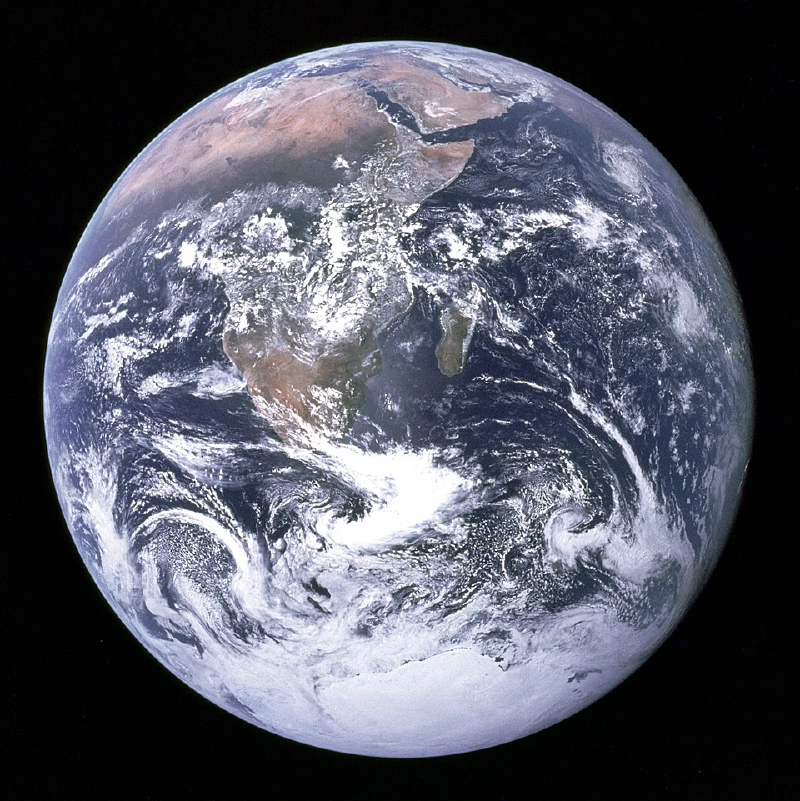
Carl Sagan expressed a similar feeling when seeing the last photo of Earth taken by the Voyager satellite from even further away:
“That’s here. That’s home. That’s us. On it everyone you love, everyone you know, everyone you ever heard of, every human being who ever was, lived out their lives… on a mote of dust suspended in a sunbeam.”

Maybe if we took a step back from living day to day and look at life in it’s entirety, we’d see that we’ve been living life upside down this whole time.
-
If you are learning something for it’s own sake, to satisfy your own curiosity, rather than learning in order to build skills, then this essay is not as applicable. I think there’s a lot of value in learning science experiment by experiment and proof by proof to build up an appreciation for the history, context, and scope of the fields. As Paul Lockhart wrote in the Mathematician’s Lament:
“It may be true that you have to be able to read in order to fill out forms at the DMV, but that’s not why we teach children to read. We teach them to read for the higher purpose of allowing them access to beautiful and meaningful ideas. Not only would it be cruel to teach reading in such a way—to force third graders to fill out purchase orders and tax forms—it wouldn’t work! We learn things because they interest us now, not because they might be useful later.” ↩︎ -
which by the way requires not only knowing thousands of characters exactly, many which are remarkably similar to each other and are used with completely different pronunciations depending on context, but also writing those strokes in the right order! At least that’s the kind of thing I got tested on in Japanese school, not that it actually matters when writing work emails. ↩︎